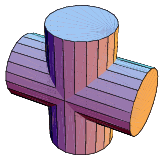
Imagine two cylinders of diameter one with axes intersecting at right angles.
- What is the volume of the space belonging to both cylinders?
- Describe the curve along the intersection you would get by "unrolling" one cylinder like a piece of paper.
(The shape of the intersection is called a "Steinmetz Solid," and Wolfram has
spoilers about it.)

3 comments:
I bet this requires using integrals or something, don't it, since you'd have a series of circles of increasing and then decreasing diameter.
God, I wish I could remember the 2-years of calculus I took in HS.
It seems like you'd just need to do a double integral from -1 <= x <= 1, -1 <= y <= 1 over some function z = f(x,y), where z describes the surface intersection of the cylinders. Since the intersection is symmetric about the X-Y plane, you'd get the volume of the top half and then double it. The only tricky part is finding what z is - it's not intuitively obvious to me.
Long, long ago this question came up, and I solved a greatly simplified version of the second question - finding the curve describing the intersection of a plane with a cylinder.
I reproduce it below in the hope it may be a starting point for the real problem:
Let C be a right circular cylinder with radius r and axis x = y = 0. Then C is described by x^2 + y^2 = r^2 (-∞ < z < ∞).
Let P be a plane which intersects C at an angle of 45 degrees. One such plane is x = z.
In order to "unroll" the cylinder, we need to map it to a plane. A mapping from the cylinder to the y-z plane is:
y' = rΘ = r *arctan(y/x)
z' = z
Then we have:
z' = z = x (from the definition of our cutting plane)
y' = r * arctan(y/x) = r * arctan[sqrt(r^2 - x^2)/x] (from the definition of the cylinder)
So y'/r = arctan[sqrt(r^2 - x^2)/x], tan(y'/r) = [sqrt(r^2 - x^2)/x]
tan^2(y'/r) = (r^2 - x^2)/x^2 = (r^2 /x^2) - 1
Then 1+ tan^2(y'/r) = (r^2 /x^2)
And as everyone knows, 1 + tan^2(u) = sec^2(u), so we have:
sec^2(y'/r) = (r^2/x^2), or:
x^2 = r^2 * cos^2(y'/r).
Thus:
x = +/- [r * cos(y'/r)]
and since x = z' from above, the equation in the y-z plane of the intersection of our plane and cylinder is:
z' = +/- [r * cos(y'/r)]
Post a Comment