Wednesday, October 10, 2007

Right triangles

Prove that a triangle with sides that can be written in the form of n2 + 1, n2 - 1 and 2n (where n > 1) is right-angled.

Show, by means of a counterexample, that the converse is false.

[from The Curious Incident of the Dog in the Night-time]
Thursday, August 16, 2007

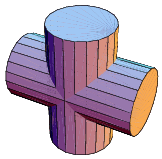
Crossing cylinders

Imagine two cylinders of diameter one with axes intersecting at right angles.

  • What is the volume of the space belonging to both cylinders?
  • Describe the curve along the intersection you would get by "unrolling" one cylinder like a piece of paper.
(The shape of the intersection is called a "Steinmetz Solid," and Wolfram has spoilers about it.)

Thursday, June 14, 2007

Irrationality

In the introduction to his book, Stuart Sutherland offers some sample questions to demonstrate to the reader that rational thinking is sporadic at best. Some are subjective ("Are you a better than average driver?") -- here are the more objective questions:
  1. Which is more likely -- that a mother with blue eyes has a daughter with blue eyes or that a daughter with blue eyes has a mother with blue eyes?
  2. Are there more words beginning with the letter 'k' than with 'k' as the third letter?
  3. Smoking increases the risk of lung cancer by a factor of ten and of fatal heart disease by a factor of two: do more smokers die of lung cancer than of heart disease?
  4. Do more people die of strokes than of accidents?
  5. Which is more dangerous, cycling or riding the Big Wheel?
  6. Consider two maternity hospitals, one averaging forty-five births a day, the other fifteen: in which hospital is it more likely that on any given day 60 per cent of births will be boys?
I wrote down six answers and expect to find the author's correct answers as I read on.

Wednesday, June 06, 2007

Sunday, January 21, 2007

Ok then, prove *this*

Steve cracked that elementary proof so easily, I thought I'd throw up another interesting one - somewhat related - which I remember from my number theory class. I haven't tried to reconstruct this one yet, but I remember it being somewhat more difficult than the infinitude of primes one.

Prove that for any natural number n, there exist n consecutive composite numbers.

Friday, January 19, 2007

This really did come up in conversation

This really belongs on the lamented Fiat Lux's "e to the pi to the i" board, but since that's no longer with us, I'll use it to check whether we still have any readers here.


Not long ago I was in Rhode Island visiting my brother and his family. Somehow the question of whether the number of primes is infinite came up in casual conversation. My sister-in-law was of the opinion that there likely is only a finite number of primes. My brother and I, both being somewhat math nerds, knew that that was contrary to fact.

"Ah-ha, but can you prove it?" Ku asked, a little smugly, knowing our best mathing years were well behind us.

It turns out I was able to recall/reconstruct the quite elementary proof in my head, right there in the kitchen. Anybody care to take a crack at it?

A couple hints:
Assume the contrary and demonstrate a contradiction.
The first step is to construct an integer with certain useful properties.