The simplest children in the streets have long known that one should switch doors when faced with the Monty Hall problem. A variant is proposed as follows:
Monty Hall presents three doors to Xavier, you, and Zebediah. Two doors conceal a goat, and one door conceals a car (assume that all contestants prefer a car to a goat). Each contestant chooses a door and communicates this choice to Monty without revealing this choice to the other contestants; if more than one contestant chooses the same door, all contestants choosing that door are awarded an instance of the prize behind it.
After each contestant has chosen a door, Monty reveals that each door has been chosen by exactly one person. He then opens the door chosen by Xavier, and there is a goat behind it. Monty offers you and Zebediah the choice to keep your respective doors or switch (again, if you both wind up with the same door you each get an instance of the prize behind it).
Should you stick or switch? Should Zebediah stick or switch?
Tuesday, September 22, 2009

Wednesday, August 05, 2009
The monkey's wheel
Someone with a British accent constructed this device:

It's a small car with two spools for wheels. A toy wheel rests on top of the spools. Pushing the car to the right causes the spools to rotate clockwise and the big wheel to rotate "anticlockwise," as expected. He then proposes to lightly set the edge of a ruler on top of the big wheel and use it to push the top of the wheel to the right. What will the car do?
One stuffed animal says the big wheel will be turned clockwise, turning the spools anticlockwise, causing the car to move to the left. Another stuffed animal says the ruler will push the car to the right, but the wheels will push it to the left, and it just won't go. A third stuffed animal says it will go to the right, but can't say why. What do you say?
Friday, July 31, 2009
A simple programming question
Suppose you have an array of 99 numbers representing the integers from 1 to 100, unordered, with one missing. What's the most efficient way to find and return the missing number?
Thursday, June 25, 2009
Stochasticity
As part of a recent Radiolab episode on randomness, the hosts visit Statistics Professor Deborah Nolan at the University of California, Berkeley. She has the class do an exercise: while she is out of the room, two groups each generate a list of one hundred coin flips. One group flips a penny and records the results as a series of H's and T's, the other group imagines they are flipping a coin and writes what they suppose the results would be.
The two lists are then written on the chalkboard. The professor returns, takes a look at the two lists, and promptly identifies which list is the result of actual coin flips and which one was faked.
How did she do it?
The two lists are then written on the chalkboard. The professor returns, takes a look at the two lists, and promptly identifies which list is the result of actual coin flips and which one was faked.
How did she do it?
Wednesday, June 17, 2009
Combinatorics for fun and profit
Score in my office:
This problem - 3
Hackers - 0
Suppose Steve and Rasalom are evenly matched at playing Azad. That is, any time Steve and Rasalom play Azad, each has a 50% chance of winning (there are no draws). Which scenario is more likely: a) Steve and Rasalom play 4 times and Steve wins exactly 3, or b) Steve and Rasalom play 8 times and Steve wins exactly 5.
Justify your answer; right guesses will be ignored, wrong guesses will be mocked.
Friday, May 29, 2009

Friday, May 08, 2009
Constrained excerpt
Anu Garg offers this passage as an example of writing with a constraint. I didn't read the rest of the article to find out what the constraint is, but these kind of things are typically based on tricks like leaving out a common letter, acrostics, or palindromic constructions.
None of the stations played anything good, but I kept at the buttons, pushing off songs from a childhood we were all supposed to have had. Commercials bothered me more than ever, news was propaganda, and traffic reports were no more useful than the weather. It wasn’t yet 1988, and I was driving home from Tacoma.The passage contains no j, q, x, or z, but these hardly qualify as common. There's no obvious pattern in word lengths, which include everything from 1 to 11. It doesn't seem like Uncleftish Beholding, either. Any ideas?
Friday, July 18, 2008
Tank production
A story is told from World War II, when the Allies were considering a ground invasion of Europe. Critical to their success would be the number of Mark V tanks fielded by the Germans. Intelligence, however, gave contradictory estimates as to the number of tanks that were being produced per month.
It was noticed that captured tanks had serial numbers, which were apparently assigned in order of production. Statisticians came up with a formula which would give an estimate of the total number of tanks produced given a sample of serial numbers. After the war, German production records showed that the estimate was almost exactly correct.
Suppose tanks are numbered 1, 2, 3, 4, 5, ... N, where N is the total number of tanks produced. Given a sample of, say, five serial numbers, how would you estimate the value of N?
Wednesday, October 10, 2007
Right triangles
Prove that a triangle with sides that can be written in the form of n2 + 1, n2 - 1 and 2n (where n > 1) is right-angled.
Show, by means of a counterexample, that the converse is false.
[from The Curious Incident of the Dog in the Night-time]
Thursday, August 16, 2007
Crossing cylinders
Imagine two cylinders of diameter one with axes intersecting at right angles.

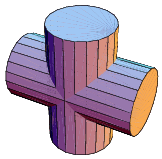
- What is the volume of the space belonging to both cylinders?
- Describe the curve along the intersection you would get by "unrolling" one cylinder like a piece of paper.
Thursday, June 14, 2007
Irrationality
In the introduction to his book, Stuart Sutherland offers some sample questions to demonstrate to the reader that rational thinking is sporadic at best. Some are subjective ("Are you a better than average driver?") -- here are the more objective questions:
- Which is more likely -- that a mother with blue eyes has a daughter with blue eyes or that a daughter with blue eyes has a mother with blue eyes?
- Are there more words beginning with the letter 'k' than with 'k' as the third letter?
- Smoking increases the risk of lung cancer by a factor of ten and of fatal heart disease by a factor of two: do more smokers die of lung cancer than of heart disease?
- Do more people die of strokes than of accidents?
- Which is more dangerous, cycling or riding the Big Wheel?
- Consider two maternity hospitals, one averaging forty-five births a day, the other fifteen: in which hospital is it more likely that on any given day 60 per cent of births will be boys?
Wednesday, June 06, 2007

Sunday, January 21, 2007
Ok then, prove *this*
Steve cracked that elementary proof so easily, I thought I'd throw up another interesting one - somewhat related - which I remember from my number theory class. I haven't tried to reconstruct this one yet, but I remember it being somewhat more difficult than the infinitude of primes one.
Prove that for any natural number n, there exist n consecutive composite numbers.
Prove that for any natural number n, there exist n consecutive composite numbers.
Friday, January 19, 2007
This really did come up in conversation
This really belongs on the lamented Fiat Lux's "e to the pi to the i" board, but since that's no longer with us, I'll use it to check whether we still have any readers here.
Not long ago I was in Rhode Island visiting my brother and his family. Somehow the question of whether the number of primes is infinite came up in casual conversation. My sister-in-law was of the opinion that there likely is only a finite number of primes. My brother and I, both being somewhat math nerds, knew that that was contrary to fact.
"Ah-ha, but can you prove it?" Ku asked, a little smugly, knowing our best mathing years were well behind us.
It turns out I was able to recall/reconstruct the quite elementary proof in my head, right there in the kitchen. Anybody care to take a crack at it?
A couple hints:
Assume the contrary and demonstrate a contradiction.
The first step is to construct an integer with certain useful properties.
Tuesday, June 20, 2006
Sudorku redorx
Another, somewhat drier, question that occurred to me: what is the total number of possible solution grids for a sudoku puzzle? I.e., how many ways are there to consruct a 9x9 grid that has "the sudoku property"?
Su dork u
So this nonsense is popular now. I really don't get it - one grid filled with numbers is about the same as another, to me. With crossword puzzles, at least, the clues can be crafted with varying degrees of cleverness - not to mention 26 > 9.
However, it irks me that there might be peabrains running around getting good at these goofy puzzles and then having a valid claim of mental superiority when I can barely solve the "medium" puzzles in the Wed./Thurs. WaPo. So I've been practicin' some. It's all kind of tedious, but the most tedious part is checking the answer when I'm done.
So here's the nut: In the absence of an answer key, what is the fastest way to check that a su-dork-u grid contains one and only one of each digit in each row, column, and 3x3 box? Put another way: Call each row, column or box an "element"; what is the minimum number of elements that need to be checked for having each digit exactly once in order to be sure that all 27 elements have that property?
Thursday, June 15, 2006

Thursday, June 08, 2006

Friday, June 02, 2006
Doctored Photo #5
This one should be within reach of casual news junkies. Ten points to whoever can identify the source.


Sunday, May 28, 2006
Find non-prime, win beer cozy
I flipped through Douglas Copeland's book JPod this afternoon and noticed this passage:
Any ideas?
Evil Mark stood up in the middle of the afternoon and said "I'm about to hand out sheets listing the 8,363 prime numbers between 10,000 and 100,000. Embedded in this list is one non-prime. First person to find that non-prime number wins my Family Guy promotional sixteen-ounce beer cozy."The next several pages contained lots of large numbers. The reference to Goldbach's Conjecture might suggest that there is an even number somewhere in the list, but that would seem a comedown from the guy who once encoded a passage in binary.
In less than five minutes I won.
FUN FACT: any even number can be made by adding together two primes.
Any ideas?
Subscribe to:
Posts (Atom)